Quick Answer
FF&E procurement in a hotel project runs through eight stages: concept and budget, FFE package definition, specification, tender and supplier selection, prototyping and mock-up, production and quality control, global shipping and customs, and on-site installation with after-sales. Each stage ends with a named deliverable and an approval gate owned by one party.
For procurement questions beyond the scope of this article, see the Karam Spaces FAQ library.
About The Author · Verified Founder Byline
The Author: Lisa Liang
Founder & Creative Visionary | Karam Spaces · CEO
Lisa is the founder of Karam Spaces and the author of its eight-stage procurement model. She has run FF&E programmes where the owner, the brand and the contractor each believed a different stage was complete — and built the model so that a project can prove, on paper, which gate has closed and which has not. She built the eight-stage model so that any project can prove, on paper, which gate has closed and which is still open.
- Role: Founder & Creative Visionary, Karam Spaces (CEO)
- Expertise: FF&E process design, gate governance, cross-party coordination
- Credentials: GOFA Member · Certified International Color Coordinator
This guide is written for hotel owners, FF&E procurement directors and project managers who need to see the whole sequence before they commit a budget. It supports one decision: which stage your project is actually in, what has to be true before you can move to the next one, and who is accountable when it is not. Durations assume a 200- to 400-key five-star project sourced from an overseas OEM factory.
Direct Answer: Hotel projects rarely fail because a stage was done slowly.
Why The Sequence Matters More Than The Speed
Hotel projects rarely fail because a stage was done slowly. They fail because a stage was skipped and the cost of it reappeared two stages later, in a place where it could no longer be fixed cheaply. A design change after tooling is a new tool. A mock-up skipped is a defect discovered on the third floor during installation. An unpriced freight line is a change order at the port. Sequence protects the budget: custom hotel furniture needs its finish and hardware decisions frozen before the tender stage, not negotiated during production.
The base rates are unforgiving. Flyvbjerg and Gardner’s database of more than 16,000 capital projects found that only 47.9% came in on budget, only 8.5% on budget and on time, and just 0.5% on budget, on time and with the promised benefits. Buildings averaged a 62% cost overrun. Procurement cannot fix a bad feasibility study, but it can remove the part of the overrun that comes from an undefined scope.
The pipeline is large enough that this discipline is now a competitive issue. Lodging Econometrics counted 15,976 projects and 2,433,948 rooms in the global pipeline at Q2 2026, including 521,849 rooms in renovation or conversion. Owners are competing for factory slots, inspection capacity and installation crews, and a project that is ready to award wins that competition against a project that is still circulating a mood board.
Direct Answer: The first two stages decide the economics of everything that follows.
Stages 1–2: Concept, Budget And FFE Package Definition
The first two stages decide the economics of everything that follows. Stage 1 sets the per-key allowance from the development budget and the brand positioning. Stage 2 converts that allowance into a zone-by-zone package with quantities, so the number has a shape.
- Stage 1 deliverable: an FF&E cost plan per key, with a separate contingency line and a stated basis (HVS benchmark, previous project, or measured quantity take-off).
- Stage 2 deliverable: a scope matrix covering every zone and every room type, with suite and connecting-room multipliers and a list of what is excluded.
- Gate: owner sign-off on both documents, with the designer confirming that the scope supports the design intent.
- Typical duration: 2–4 weeks, and it should not start before the key count is stable.
A useful test at this gate: could two suppliers price this package and produce bids that differ by less than 10% for reasons of price rather than scope? If not, the package is not defined. Most “cheapest bid” problems are born here, not at the tender.
Direct Answer: Stage 3 is where the hotel furniture spec book is written: dimensions and tolerances, materials and finishes, performance tests, compliance documents and mock-up requirements.
Stages 3–4: Specification, Tender And Supplier Selection
Stage 3 is where the hotel furniture spec book is written: dimensions and tolerances, materials and finishes, performance tests, compliance documents and mock-up requirements. Stage 4 is where those requirements become comparable prices. Stage 3 is where hotel furniture procurement either becomes a controlled process or a series of exceptions; issue one specification pack to every bidder.
The most valuable artefact in this pair is the line-item comparison, not the total. A total tells you which supplier is cheapest. A line-item comparison tells you why — and whether the difference is a real saving or a missing scope item that will be added back as a change order.
Direct Answer: Stage 5 builds the proof: finish samples, a golden sample per critical SKU, and a full mock-up room installed in the actual lighting.
Stages 5–6: Prototyping, Production And QC Inspection
Stage 5 builds the proof: finish samples, a golden sample per critical SKU, and a full mock-up room installed in the actual lighting. Stage 6 turns that proof into volume, with in-process checks and a pre-shipment inspection that releases the container. For coastal properties, require the resort furniture supplier to submit an outdoor mock-up alongside the guestroom one, tested against the same salt and UV criteria.
This is where the schedule usually slips, and it slips in the approval loop rather than on the factory floor. A mock-up takes 25–30 working days including sample shipping, plus 5–7 days for review. Two approval rounds are normal. A third round means the design was not frozen at Gate 1, and the cost is not only time: at that point, material may already be cut.
The durability standards are worth naming in the purchase order, because they convert quality into evidence. ANSI/BIFMA X5.1-2017 (R2022) back durability runs 120,000 cycles with a 240 lb seat load and a 100 lbf back force; ANSI/BIFMA X5.4-2020 (R2025) covers public and lounge seating. A supplier that can produce those reports against the delivered model has a quality system. One that cannot is asking you to trust a sample.
Direct Answer: Stage 7 is logistics, but it is also a design decision.
Stage 7: Global Shipping, Customs And Delivery
Stage 7 is logistics, but it is also a design decision. Packing specification, container loading sequence and Incoterm all determine what arrives intact and who pays when it does not. Drewry’s World Container Index stood at USD 4,305 per 40ft container on 12 November 2026, with Shanghai–Los Angeles at USD 7,416 and Shanghai–Rotterdam at USD 3,504 — a reminder that the freight line in a budget is a moving number, not a fixed one.
The stage’s deliverables are a container plan by zone, a packing list by container, a customs file with HS codes agreed at PO stage, and a delivery schedule that matches site readiness. The gate is departure: nothing sails until the pre-shipment report is signed and the documents have been pre-audited by the broker.
Direct Answer: Stage 8 is where the owner meets the product.
Stage 8: On-Site Hotel Furniture Installation And After Sales
Stage 8 is where the owner meets the product. Installation should be sequenced by zone — back of house, then public areas, then guest floors, then outdoor — so that the areas needed for staff training and pre-opening inspections are finished first. Snagging should be logged by SKU and room number, with a defect code, a photograph and a target date. Closeout should include a spare-parts matrix for custom resort furniture, since woven and marine-grade components age differently from indoor casegoods.
After-sales is part of the same stage, not a separate courtesy. A five-star hotel needs a warranty process, a spare-parts list and a named contact who answers within a stated time. The cost of getting this wrong is visible to guests: J.D. Power’s 2025 North America study found that when a guest experiences a problem, satisfaction falls 217 points, from 677 to 460, even though only 12% of stays involve a problem. A wobbly chair or a broken drawer handle is exactly that kind of problem.
The stage gate is final acceptance: a signed handover pack containing the as-built drawing set, warranty certificates, care and maintenance instructions, spare-parts inventory, and the closed defect log. Without that pack, the project is installed but not handed over.
Direct Answer: The same eight stages apply to an urban select-service hotel and a Red Sea resort, but the risk profile changes.
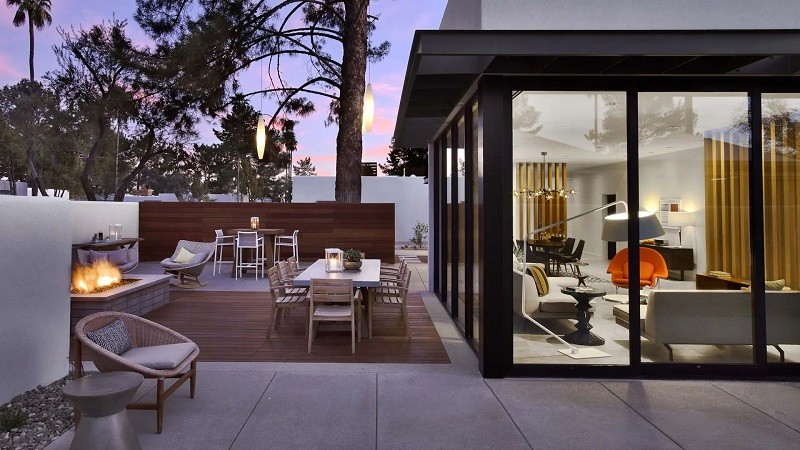
The same eight stages apply to an urban select-service hotel and a Red Sea resort, but the risk profile changes. A city hotel can install in phases and keep selling rooms; a resort has one opening window and no second chance. A humid coastal site needs moisture-resistant substrates and stainless hardware; a desert site needs UV-stable finishes and a specification that tolerates 45°C outdoor exposure. A heritage conversion needs a survey stage before Stage 3, because the walls are not square and the millwork interfaces have to be measured rather than drawn.
Direct Answer: Buyers ask three questions most often.
The Hotel Furniture Spec Book: Expert Answers For Hotel Buyers
Buyers ask three questions most often. How many fields does a spec sheet need? Fourteen is enough to be unambiguous. Who signs the specification? The designer recommends, the owner’s technical lead approves, and the brand approves compliance — three signatures, one document. When is the spec frozen? At Gate 1, before tooling; after that, every change is a priced change order. Our hotel furniture spec book guide answers the rest field by field.
Direct Answer: Before a specification is released, confirm six things: the key count and room types are final; the brand standard edition is current; the per-key allowance includes freight, duty and installation; the mock-up scope and date are booked; the factory slot is hel
Hotel Furniture Project Management: What To Check Before You Specify
Before a specification is released, confirm six things: the key count and room types are final; the brand standard edition is current; the per-key allowance includes freight, duty and installation; the mock-up scope and date are booked; the factory slot is held; and the installation sequence has been agreed with the main contractor. If any one of those is open, the specification will change, and a specification that changes is a schedule that moves.
Our hotel furniture project management framework for multi-property rollouts extends these eight stages across several assets at once. For the products covered by each stage, see indoor hotel furniture and outdoor hotel furniture; for stage 7 progress, hotel furniture order tracking shows where a container actually is.
Frequently Asked Questions
Q1: What are the stages of FF&E procurement in a hotel project?
Eight: concept and budget, FFE package definition, specification, tender and supplier selection, prototyping and mock-up, production and QC, shipping and customs, and installation with after-sales. Each stage ends with a deliverable and a single accountable approver.
Q2: Which stage causes the most delay?
Stage 5, prototyping and mock-up, because it depends on approvals from four parties. A mock-up takes 25–30 working days plus review, and a second round is common. Freezing the design earlier is the only reliable way to shorten it.
Q3: Who is accountable for FF&E procurement?
The owner is accountable overall and approves budget and gates. The procurement director runs tender and award, the designer owns specification and mock-up sign-off, and the supplier owns production, QC and delivery. Each stage should have exactly one accountable party.
Q4: How long does the full FF&E process take?
Plan 32–40 weeks from design freeze to final acceptance for an overseas package, or 20–26 weeks domestically. Add 6–8 weeks before design freeze for concept, budget and specification.
Next Step
If you want to know which stage your project is really in, send us the current document set — budget, scope matrix, spec book, drawings or draft RFP. We will map it against the eight stages and tell you which gate you have not actually closed. That review is free and takes five working days. Request a hotel furniture quote to start, or work with a hotel furniture supplier who will run all eight stages under one contract. Definitions and timelines are also covered in our hotel furniture FAQ.